Understanding how does switchgear work begins with a simple scene: a feeder suddenly develops a short circuit. Current rises sharply, copper conductors heat, and an arc may form within milliseconds. Switchgear detects, interrupts, isolates, and safely redirects electrical energy.
Electrical engineer John D. McDonald, an IEEE Fellow and power-system protection specialist, expresses a useful principle: “Protection is a system function, not merely a device function.” This idea matters because reliable switchgear depends on coordinated relays, circuit breakers, busbars, grounding, insulation, and maintenance. One component cannot compensate for a poorly designed system.
This guide examines seven important switchgear types, including air-insulated, gas-insulated, metal-clad, metal-enclosed, vacuum, SF6, and hybrid designs. Each type manages faults differently. A vacuum interrupter extinguishes an arc inside a sealed bottle. An air-insulated panel uses clearances and barriers around energized parts. Gas-insulated equipment saves space, but it demands careful sealing and environmental control.
The operating sequence is precise. A relay senses abnormal current. It sends a trip signal. The circuit breaker opens its contacts. Arc-control technology then limits and extinguishes the electrical arc. Downstream equipment remains protected, if coordination is correct.
Small details matter.
A loose connection can create dangerous heat. A delayed relay may increase equipment damage. A neglected inspection can weaken confidence in the entire installation. The explanation is not perfect without site conditions, voltage levels, fault calculations, and maintenance records. Those limitations deserve attention. With that practical view, the following sections explain how switchgear works and where each type performs best.
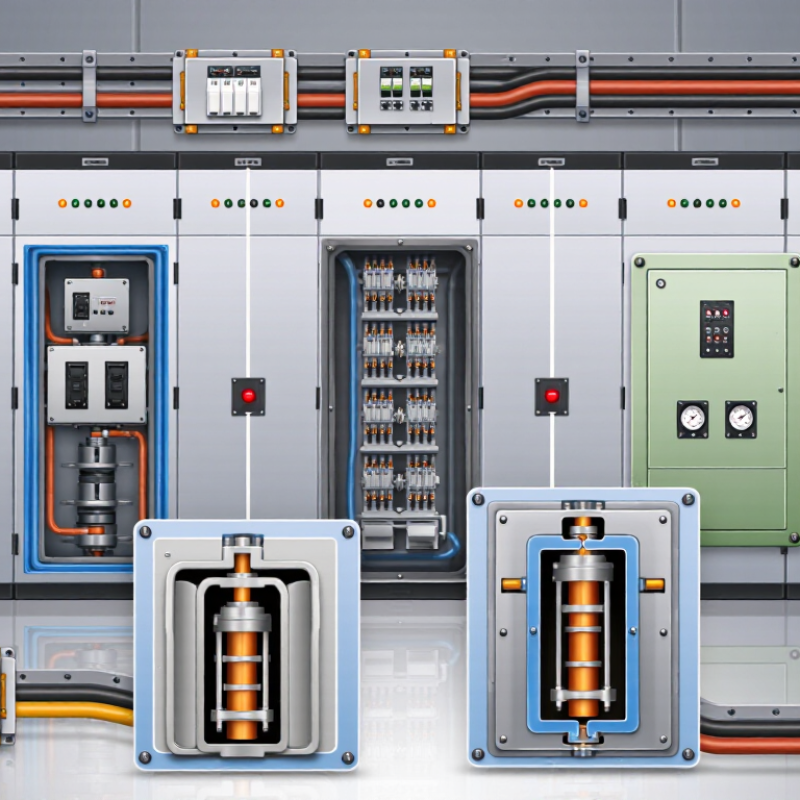
Switchgear protects, controls, and isolates electrical circuits when power systems operate normally or face faults. It works by routing current through switching devices, then opening the circuit when sensors detect dangerous conditions. A circuit breaker may interrupt a short circuit within milliseconds. This action protects cables, transformers, equipment, and nearby workers.
The seven common types include air-insulated, gas-insulated, vacuum, oil, low-voltage, medium-voltage, and high-voltage switchgear. Each design suits different voltage levels, space limits, maintenance plans, and environmental conditions.
Vacuum switchgear often reduces fire risks, while gas-insulated equipment saves space. However, gas handling requires strict procedures. During inspections, technicians check contact wear, insulation surfaces, mechanical movement, grounding, and relay settings. A small loose connection can create heat before anyone notices it. That detail is easy to underestimate.
Tips: Select equipment by voltage, fault current, enclosure rating, and installation environment. Keep clear labels on every feeder. Test protection relays according to applicable IEC or IEEE requirements, and record each result. Never depend only on visual checks. Dust, moisture, and aging seals can remain hidden. Qualified personnel should isolate, lock, and verify circuits before maintenance. One practical lesson deserves attention: a technically correct switchgear system can still fail when operators lack training or records are incomplete.
Switchgear controls, protects, and isolates electrical circuits under normal and abnormal conditions. It combines switching devices, protective relays, busbars, and measurement equipment inside a controlled enclosure. Operators can energize a feeder, redirect power, or shut down equipment for maintenance. The exact arrangement depends on voltage, fault levels, space, and operating conditions.
During a fault, a relay detects abnormal current or voltage. It sends a trip signal to a circuit breaker. The breaker opens rapidly, stopping current from reaching damaged equipment. Arc-control technology helps manage the intense energy created during interruption. Vacuum, air-insulated, gas-insulated, and solid-insulated designs use different methods. Each type has practical benefits and limitations.
Isolation creates a visible or verified separation between energized and de-energized sections. This step protects maintenance personnel and reduces accidental energization risks. Interlocks can prevent unsafe switching sequences, although no interlock replaces proper verification. A technician should check indicators, test for absence of voltage, and apply grounding procedures before work begins.
In real installations, dust, moisture, aging contacts, and incorrect settings can reduce performance. That gap matters. Regular inspection, relay testing, thermal scanning, and accurate maintenance records improve reliability. I have found that the best switchgear is not simply the most advanced. It is the equipment correctly matched to the system, installed carefully, and tested under realistic conditions.
7 Best Switchgear Types: How Does Switchgear Work?
Switchgear controls, protects, and isolates electrical circuits in commercial and industrial systems. Its main enclosure shields energized parts from dust, moisture, and accidental contact. Inside, copper or aluminum busbars distribute current between incoming and outgoing feeders. Circuit breakers interrupt fault current, while disconnectors create visible isolation during maintenance. Earthing switches safely discharge trapped energy before technicians approach conductors. Small details matter.
Current transformers and voltage transformers provide measurements without exposing instruments to full system voltage. Protective relays analyze abnormal conditions, such as overloads, short circuits, and earth faults. When danger is detected, the relay signals the breaker to open within a controlled time. Mechanical and electrical interlocks prevent unsafe switching sequences. Arc-resistant designs may guide hot gases through reinforced vents, reducing injury risks near the cabinet. It must open.
From field inspections, loose connections often reveal themselves through heat marks, unusual odors, or uneven noise. Thermal scanning and torque checks can identify problems early, although inspection results depend on proper procedures and trained personnel. No switchgear design is flawless. A relay setting may look correct on paper but fail to match changing loads, cable lengths, or fault levels. Regular testing, accurate records, and verified isolation remain essential. A locked handle alone does not prove that equipment is dead. Voltage testing and approved grounding practices provide stronger evidence before work begins.
| Switchgear Type | Typical Voltage Range | How It Works | Main Components | Primary Applications | Key Safety Functions |
|---|---|---|---|---|---|
| Low-Voltage Switchgear | Up to 1 kV AC | Controls, distributes, and isolates electrical power in low-voltage systems. Circuit breakers or fuses interrupt current when a fault occurs. | Circuit breakers, fuses, busbars, contactors, meters, protective relays, enclosures, and earthing conductors | Commercial buildings, industrial facilities, data centers, motor control centers, and utility auxiliary systems | Overcurrent protection, short-circuit interruption, overload protection, equipment isolation, and protection against accidental contact |
| Medium-Voltage Switchgear | More than 1 kV to 36 kV | Uses switching devices and protection systems to manage distribution feeders, transformers, and motors at medium voltage. | Vacuum or gas circuit breakers, disconnectors, earthing switches, current transformers, voltage transformers, relays, and busbars | Factories, substations, renewable-energy plants, hospitals, commercial complexes, and distribution networks | Fault detection, selective tripping, visible or mechanical isolation, interlocking, arc containment, and feeder protection |
| High-Voltage Switchgear | Above 36 kV | Switches and circuit breakers control high-energy transmission or subtransmission circuits while specialized insulation and protection systems manage electrical stress. | High-voltage circuit breakers, disconnectors, earthing switches, instrument transformers, surge arresters, busbars, and protection relays | Transmission substations, large power plants, utility networks, and high-capacity industrial sites | High-speed fault clearing, insulation coordination, surge control, remote operation, grounding, and separation of energized equipment |
| Air-Insulated Switchgear (AIS) | Commonly low- and medium-voltage; also used at high voltage | Air provides insulation between energized conductors and grounded metal. Switching devices open or close the circuit and extinguish the arc using an appropriate interrupting medium. | Open or metal-enclosed busbars, circuit breakers, disconnectors, instrument transformers, relays, shutters, and grounding switches | Indoor electrical rooms, outdoor substations, industrial distribution, and utility facilities | Compartmentalization, mechanical interlocks, grounding, clearances, arc-resistant construction where specified, and access control |
| Gas-Insulated Switchgear (GIS) | Usually medium- and high-voltage | Conductors and switching devices are enclosed in grounded metal compartments filled with an insulating gas or gas mixture, allowing compact construction. | Gas-insulated busbars, circuit breakers, disconnectors, earthing switches, gas-density monitors, instrument transformers, and sealed enclosures | Space-constrained substations, urban networks, underground installations, offshore facilities, and high-reliability power systems | Sealed enclosure protection, gas-pressure monitoring, interlocking, reduced exposure to live parts, arc containment, and controlled grounding |
| Vacuum Switchgear | Commonly used from low voltage through medium voltage | A vacuum interrupter separates its contacts and rapidly extinguishes the arc because the sealed vacuum has high dielectric strength and few ionizable particles. | Vacuum interrupter, operating mechanism, circuit breaker, spring or motor charging system, protection relay, and control circuitry | Motor feeders, transformers, industrial plants, commercial substations, and medium-voltage distribution systems | Fast arc extinction, low maintenance, overload and short-circuit protection, electrical interlocking, and safe isolation |
| Oil-Insulated Switchgear | Historically used across medium- and high-voltage systems | Insulating oil separates energized parts and helps cool and extinguish the arc when contacts open. New installations often use other technologies because of fire and maintenance considerations. | Oil circuit breaker, oil tank, contacts, operating mechanism, bushings, oil-level indicators, protection relays, and containment system | Legacy substations, older industrial installations, and selected outdoor electrical systems | Overcurrent interruption, insulation, cooling, oil-level monitoring, fire containment, grounding, and preventive oil testing |
| How Switchgear Works: Switchgear receives electrical power, distributes it through busbars and feeders, monitors current and voltage, detects abnormal conditions through protective relays, and isolates the faulty section by opening a circuit breaker or fuse. Disconnectors provide safe separation after the load current has been interrupted, while earthing switches discharge and ground isolated equipment before maintenance. | |||||
| Core Safety Functions: Short-circuit protection, overload protection, earth-fault protection, arc-flash risk reduction, equipment isolation, grounding, mechanical and electrical interlocking, status indication, remote control, and prevention of unauthorized access to energized compartments. | |||||
7 Best Switchgear Types: How Does Switchgear Work?
Switchgear controls, protects, and isolates electrical circuits. When a fault occurs, a relay detects abnormal current and signals a circuit breaker. The breaker opens its contacts, stopping the fault current. Isolators then create a visible separation for maintenance, while grounding switches discharge trapped energy. Proper coordination matters; a slow breaker can expose cables and equipment to severe damage.
Seven common switchgear types have different applications and construction features. Low-voltage switchgear serves buildings and small industrial systems. Medium-voltage switchgear supports factories, substations, and distribution networks. High-voltage switchgear manages transmission-level power. Metal-enclosed switchgear places components inside a protective housing. Metal-clad switchgear adds separated compartments and stronger internal barriers. Air-insulated switchgear uses atmospheric air, making inspection simpler and costs lower. Gas-insulated switchgear uses sealed insulating gas, saving space but requiring careful leak monitoring and specialized servicing. These categories can overlap, which sometimes makes selection confusing.
Tips: Check voltage, fault-current ratings, busbar capacity, enclosure protection, and available maintenance space. Confirm relay settings through a documented coordination study. Inspect contact wear, insulation surfaces, and mechanical interlocks regularly. Do not rely on appearance alone. A clean panel may still contain aging insulation or loose connections. Design decisions should follow applicable IEC, IEEE, and local electrical requirements, with testing performed by qualified personnel. Small documentation gaps can become serious safety problems.
Choosing switchgear starts with the application, not the catalogue. Low-voltage panels suit commercial buildings and small industrial loads. Medium-voltage metal-enclosed gear fits factories, substations, and renewable-energy collection systems. The selection must match system voltage, continuous current, short-circuit rating, switching frequency, and installation environment. Fit matters. A dusty workshop needs stronger enclosure protection than a clean control room. Outdoor equipment may require weather sealing, heating, and corrosion-resistant materials.
Switchgear works by detecting abnormal current and opening a circuit through a circuit breaker. Relays issue the trip signal, while disconnectors provide visible isolation for maintenance. IEEE 1584-2018 is widely used for arc-flash energy calculations, so protection settings should reflect actual fault studies, not assumptions. IEC 62271-200 covers metal-enclosed AC switchgear above 1 kV and up to 52 kV. According to the International Energy Agency’s Electricity 2024 report, global electricity demand is expected to grow by an average 4% annually through 2026. That growth increases the need for dependable distribution and flexible protection. MarketsandMarkets’ 2024 Switchgear Market report projects the sector will reach approximately USD 134 billion by 2029. However, bigger demand does not make every advanced feature necessary. Digital monitoring can reveal temperature rise, partial discharge, and breaker wear, but it also adds configuration and maintenance responsibilities. A neat specification can still fail in real service. Review load growth, humidity, operator access, spare parts, and testing procedures with qualified engineers before approval.
Switchgear protects, controls, and isolates electrical circuits by interrupting fault currents and safely directing power. The chart compares representative maximum voltage levels commonly associated with seven switchgear types. Actual ratings depend on the system design and applicable standards.
How to choose: Low-voltage switchgear is suitable for buildings and industrial distribution up to 1 kV. Medium-voltage systems commonly serve utilities, factories, and commercial facilities from above 1 kV to 36 kV. High-voltage, air-insulated, and gas-insulated switchgear are used in transmission and substations. Metal-enclosed and metal-clad designs provide compartmentalization and improved operator safety for distribution applications.
Switchgear controls, protects, and isolates electrical circuits. It can energize feeders, redirect power, or shut down equipment safely.
A protective relay detects abnormal current or voltage. It sends a trip signal to a circuit breaker. The breaker opens quickly.
Common parts include busbars, circuit breakers, disconnectors, relays, transformers, and grounding switches. The enclosure protects energized components from contact and contamination.
Isolation creates a visible or verified separation from live circuits. Workers should test for absent voltage and apply approved grounding procedures.A locked handle is not enough.
Mechanical and electrical interlocks prevent dangerous switching sequences. However, interlocks can fail or be misunderstood. Verification remains necessary.
Air-insulated designs are easier to inspect and often need more space. Sealed gas-insulated designs save space but require leak monitoring and specialized service.
Dust, moisture, aging contacts, loose connections, and incorrect relay settings can reduce performance. Heat marks, unusual odors, and uneven noise may reveal trouble.
Technicians should perform relay tests, thermal scans, torque checks, contact inspections, and mechanical tests. Accurate maintenance records matter.Small gaps become serious.
They should check voltage, fault-current ratings, busbar capacity, enclosure protection, and maintenance space. The best equipment is not always the most advanced.
Switchgear is an essential part of electrical power systems because it manages the flow of electricity while helping protect people, equipment, and circuits. If you ask, “how does switchgear work,” the answer is that it uses switching devices, protective relays, fuses, circuit breakers, and isolators to control current, detect abnormal conditions, interrupt faults, and safely separate equipment for inspection or maintenance. Its main safety functions include overload protection, short-circuit interruption, fault isolation, and reliable system control.
The seven common switchgear types are low-voltage, medium-voltage, high-voltage, air-insulated, gas-insulated, metal-enclosed, and metal-clad switchgear. Each type offers different advantages in terms of voltage capacity, insulation method, space requirements, maintenance needs, and operating environment. Choosing the right option depends on the system’s voltage level, load characteristics, fault ratings, installation location, safety requirements, expansion plans, and budget. A suitable switchgear arrangement can improve power reliability, simplify maintenance, and reduce operational risks.

Zago Electric